The promise to his mother
Promise at DawnThe promise to his mother is the organizing commitment behind Romain Gary’s life as he recounts it: he must survive, accomplish what she imagined for him, and make her own gifts and ambitions visible to the world. It gives a private family bond public forms—military service, literary work, and service to others—and continues to shape his life after his mother is dead.
Origins and Obligations
His mother’s expectations make the promise feel less like a single pledge than a life plan. As he lies gravely ill, he measures himself against the futures she had imagined: he has become neither Jascha Heifetz nor a French ambassador, and has not yet achieved success with women or become a Frenchman. Even the ping-pong championship he won in Nice in 1932 becomes a comically modest achievement he cannot bear to have missed. His fear is not simply death; it is leaving his mother unsupported and failing to fulfill what she expects of him.
The commitment takes shape against actual dependence and loss. His father left soon after his birth, and Romain learned to avoid the subject after noticing that his mother and Aniela changed it whenever he raised the man’s name. Much later, in 1958, a letter informed him that his father had died of fright before reaching a German gas chamber, where he was to be executed as a Jew with his wife and two children. Romain received the news in Paris while about to accept the Prix Goncourt for The Roots of Heaven. The letter left him numb. The account does not make his promise a response to his father’s fate; rather, it sets the mother-son bond within a family history marked by absence and devastating loss.
Survival as a Test of the Promise
During his illness, Romain understands staying alive as a responsibility to his mother. After scarlet fever, an acute kidney inflammation leaves doctors expecting him to die. He worries that she will be left without support and that her hopes for him will remain unfulfilled. He tries to smile and speak coherently when she leans over him, wanting her to see him fighting rather than giving up. His determination turns survival into a form of duty: his life, as he later explains, is not solely his own but an instrument for the justice he believes he owes her.
His mother’s refusal to allow an operation on his right kidney becomes another expression of the same intense, if sometimes comic, investment in his future. She rejects the doctors’ recommendation despite the presence of a German specialist summoned at great expense. Romain later understands that she feared the operation would diminish his sexual capacity; assurances that he could still have a normal sex life only intensified her opposition, because normality fell short of what she imagined for him. He keeps the kidney, the specialist predicts that he has only days to live, and Romain survives. The episode shows how her expectations could govern practical decisions as well as the grand ambitions she assigned him.
Years later, typhoid in Damascus brings the promise to a more extreme crisis. Romain has internal hemorrhages, receives transfusions, and is considered unlikely to recover. In delirium, he sees himself returning to Nice beside his decorated mother, celebrated for her own service. The imagined scene makes artistic achievement and maternal vindication inseparable: he believes he has made a masterpiece by shaping their future into a story that defeats absurdity. His resolve to keep living is therefore also a refusal to let his mother’s life end, in his imagination, without recognition or justice.
From Achievement to Service
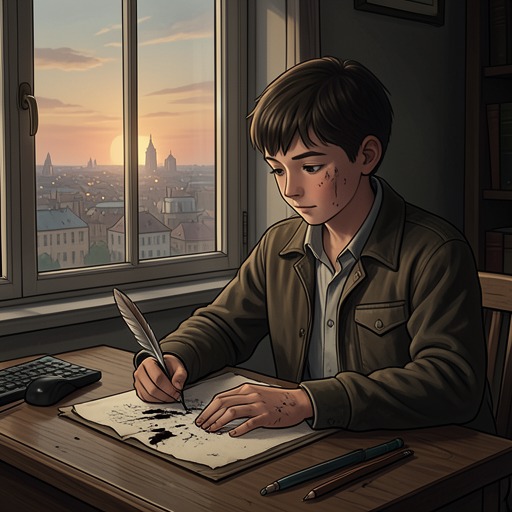
The promise directs his ambitions beyond survival. He wants to return with victories, write War and Peace, become an ambassador of France, and give his mother the chance to see her talent made manifest. These aims join military distinction to artistic work: he does not treat writing as a substitute for life or combat, but as another way of giving experience shape and meaning. At Hartford Bridge, while serving with his squadron in England, he writes through freezing nights in a shared hut, then flies missions at dawn. He fears going home empty-handed and imagines his mother seeing her name on the cover of a book. Literary fame, in this account, is one means of realizing her artistic ambitions.
After receiving the Cross of the Liberation from Charles de Gaulle, Romain promptly sends a telegram to Switzerland so his mother can hear the news. He also arranges for a cautiously worded letter to reach her in Nice. The honor matters to him not simply as recognition of his own service, but as something he can bring home to the woman whose hopes have guided him. His book and his decoration answer different parts of the same obligation: one gives her artistic fame, the other the military honor he believes she deserves.
The Promise After Her Death
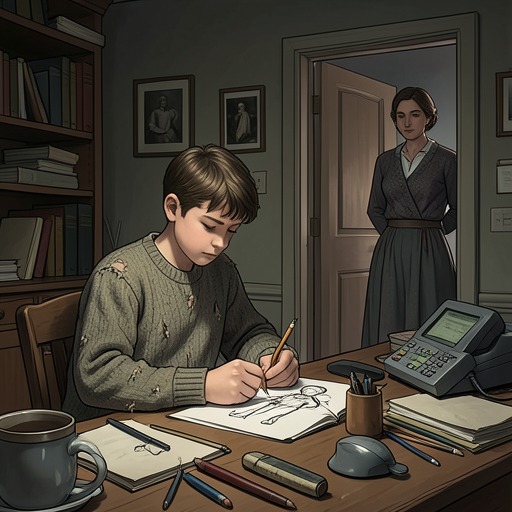
When Romain returns to the Hôtel-Pension Mermonts after liberation, he discovers that his mother died three years and six months earlier, only weeks after he departed for England. She had arranged for nearly two hundred and fifty undated letters to be sent to him at intervals through a friend in Switzerland. The letters concealed her death and continued to provide the support he thought he was still receiving. He understands them as a final act of care, prepared because she believed he remained too weak to stand alone and fight as a Frenchman without her presence. The promise had seemed to run from son to mother; her plan reveals how actively she continued to sustain it from her side.
In later life, Romain says he has kept the promise and will continue to do so. He has served France wholeheartedly because it is what remains of his mother, apart from a small snapshot. He has written books, built a career, and tried to help other living beings. He recalls freeing a hummingbird trapped overnight in his Los Angeles home and intervening when a hunter aimed at a gazelle feeding its young. These episodes are not presented as equivalent to his earlier ambitions, but as evidence that he has tried to honor his undertaking through acts of care. At Big Sur, the sea and animals renew his longing for a tenderness broad enough to reach beyond human life. The promise thus survives its original recipient: it becomes a continuing discipline of service, creation, and compassion.